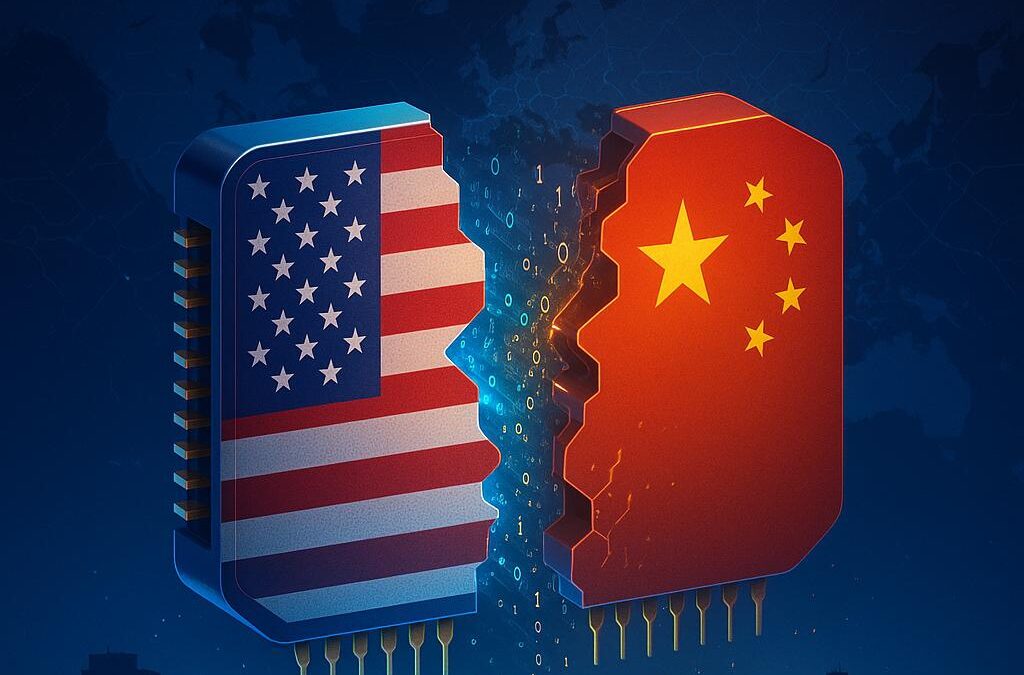
When Silicon Meets Sanctions: How Global AI Technology Trade Wars Impact Your Business 🌐
The U.S. just blocked NVIDIA’s AI chips to China – here’s what it means for your business
Hey folks, if you thought keeping up with technology was tough before, wait till you hear what’s happening with global AI technology right now! The U.S. government just dropped another bombshell on the tech world, and this time it’s about those fancy computer chips that power everything from ChatGPT to your smart inventory system.
According to Reuters, the Biden administration is blocking NVIDIA from selling even their scaled-back AI chips to China. We’re not talking about just the super-powerful ones anymore – even the “lite” versions are off-limits! It’s like watching a high-stakes poker game where the chips (pun intended) are worth billions, and your business might be holding cards whether you know it or not. 🎰
What We’ll Cover:
Understanding the Global AI Technology Landscape Shift 🗺️
So what’s really going on here? The global AI technology market is fundamentally changing from a free-market paradise to a politically divided battlefield. The U.S. government is essentially saying, “These AI chips are too powerful to share,” and that’s creating ripple effects you’ll feel from Silicon Valley to your local Main Street.
The Information reports that this isn’t just about one company or one product. We’re witnessing a complete restructuring of how AI technology flows around the world. Think of it as the tech equivalent of the Berlin Wall, but instead of dividing a city, it’s dividing the entire digital economy.
What This Means in Practical Terms:
- Businesses worldwide are choosing sides in a tech cold war
- The days of simply buying the best technology for the best price are fading
- Your vendor choices now have geopolitical implications
#TechPolicy #AIRegulations #GlobalTrade
The Reality of Gray-Channel GPUs in Global Markets 💻
Here’s where global AI technology gets really interesting for business owners. When official channels close, unofficial ones open up. The report mentions “gray-channel GPUs” – essentially, these are chips being sold through alternative, sometimes questionable channels to get around restrictions.
⚠️ Warning: Gray Market Reality Check
Industry analysts from Semiconductor Intelligence estimate that gray market premiums for AI chips have increased 150-300% in restricted regions. That’s not speculation – that’s what’s happening right now!
For Small and Medium Businesses, This Means:
- Higher costs for AI-powered tools in certain regions
- Uncertainty about the legitimacy of hardware sources
- Potential legal risks if you unknowingly purchase restricted technology
- Supply chain disruptions that could affect your vendors and partners
#GrayMarket #SupplyChain #BusinessRisk
Regional Model Forks: When AI Development Splits 🔀
The concept of “regional model forks” mentioned in the coverage is crucial for understanding where global AI technology is heading. Instead of one global AI ecosystem, we’re seeing the emergence of separate, parallel development paths.
China, faced with chip restrictions, is accelerating development of its own AI models that work with domestically produced hardware. Meanwhile, U.S. allies are doubling down on American technology stacks. According to the Center for Strategic and International Studies, this bifurcation could lead to incompatible AI systems that can’t communicate effectively across borders.
🚨 Key Implications for Your Business:
- Software and AI tools may work differently depending on their origin
- International collaborations could become more complex
- Data sharing and system integration across borders might face new challenges
- Training and support resources could become region-specific
This isn’t science fiction – it’s happening now, and it affects everything from your customer service chatbots to your predictive analytics tools.
#AIFragmentation #TechSovereignty #DigitalDivide
🎯 Plot Twist: Allied Markets Double-Down
While China seeks alternatives, U.S. allies are doing the opposite with global AI technology – they’re consolidating around American technology stacks. Japan, South Korea, Australia, and European nations are increasingly aligning their AI infrastructure with U.S. standards and suppliers.
According to a Brookings Institution report, this consolidation could create two distinct tech spheres: one centered on U.S. technology and another seeking independence from it.
Critical Takeaways for Small and Medium Businesses 📊
Let’s get down to brass tacks – what does all this global AI technology drama mean for your business? Here are the essential points you need to understand:
Your Tech Stack Has Political Implications Now
Whether you like it or not, your choice of technology vendors might affect your ability to do business in certain markets. That AI-powered tool you’re using? Check where it’s from and what chips it runs on.
Costs Are Going Up (In Some Places)
If you or your partners operate in restricted regions, expect to pay more for AI capabilities. Budget accordingly and consider alternative solutions.
Diversification Is No Longer Optional
Having backup vendors and alternative solutions isn’t paranoid – it’s prudent. The tech landscape is shifting rapidly, and single-source dependencies are risky.
Compliance Is Getting Complicated
Export controls, data sovereignty laws, and technology restrictions mean you need to pay attention to the legal aspects of your tech choices.
Innovation Paths Are Diverging
The AI tools and capabilities available to you might differ significantly based on your location and partnerships. Stay informed about what’s available and what’s coming.
#BusinessStrategy #RiskManagement #Compliance
🔐 Security Implications in a Divided Tech World
The fragmentation of global AI technology creates new security challenges that every business needs to consider. The Cybersecurity and Infrastructure Security Agency (CISA) has warned about increased risks from:
- Counterfeit chips entering the supply chain
- Unvetted hardware with potential backdoors
- Compromised software from unreliable sources
- Increased targeting by cybercriminals exploiting confusion
Practical Security Steps:
- Implement strong authentication (like Duo.com for 2FA, not SMS)
- Use reputable password managers (1Password is solid)
- Deploy robust endpoint protection (Windows Defender for Windows, Cisco Umbrella for business networks)
- Regular security audits of your tech stack
What’s In It for Small and Medium Businesses? 💼
Despite the challenges, this reshaping of global AI technology creates opportunities for nimble SMBs:
✅ Competitive Advantages:
- Large corporations struggle with legacy systems; you can adapt faster
- New vendors seeking market share may offer better deals
- Regional specialization could open niche markets
- Innovation in workarounds could become valuable expertise
💰 Cost Considerations:
- Initial disruption costs vs. long-term strategic positioning
- Potential for better pricing as competition increases
- Investment in flexibility pays dividends during uncertainty
🚀 Strategic Opportunities:
- First-mover advantage in emerging tech ecosystems
- Partnership opportunities with businesses needing navigation help
- Consulting potential for businesses that figure it out early
📬 Stay Ahead of the Curve!
Don’t let these changes catch you off guard! Get weekly insights on how global tech shifts affect your business.
Sign Up for Craig’s Insider Notes Newsletter →
Free weekly updates • No spam • Unsubscribe anytime
Action Items for Business Leaders 🎯
Here’s what you need to do about global AI technology changes RIGHT NOW:
1. Audit Your Current Technology
- List all AI-powered tools and services you use
- Identify their origins and dependencies
- Assess vulnerability to trade restrictions
2. Develop Contingency Plans
- Identify alternative vendors for critical systems
- Create switching protocols and timelines
- Budget for potential transition costs
3. Stay Informed and Connected
- Monitor policy changes affecting your industry
- Join industry groups discussing these challenges
- Sign up for updates at CraigPeterson.com for weekly insights
4. Strengthen Security Posture
- Implement robust authentication methods
- Regular security audits
- Employee training on emerging threats
5. Build Flexibility Into Planning
- Avoid long-term vendor lock-ins where possible
- Maintain documentation for easy system transitions
- Regular review of tech strategy alignment
Final Conclusion: Embracing the New Reality 🌟
The transformation of global AI technology from an open marketplace to a politically divided landscape is not a temporary blip – it’s the new normal. The Reuters report on NVIDIA’s restricted chip sales is just one chapter in an ongoing story that will define the next decade of business technology.
For small and medium businesses, this isn’t a crisis – it’s a clarion call to become more strategic, more informed, and more flexible in your technology decisions. The businesses that recognize this shift and adapt accordingly won’t just survive; they’ll find opportunities that didn’t exist in the old, simpler world.
The key message? Global AI technology is no longer just about features and price points. It’s about understanding geopolitical realities, building resilient systems, and maintaining the flexibility to navigate an increasingly complex landscape.
Your technology choices now have implications beyond your IT department – they affect your market access, your costs, your security, and your competitive position. The winners in this new environment won’t necessarily be those with the most advanced technology, but those who best understand and adapt to the changing rules of the game.
The Bottom Line for Your Business
Stay informed, stay flexible, and most importantly, stay engaged with these changes. What you don’t know about global AI technology really can hurt you – and your bottom line. The businesses that thrive will be those that:
- ✅ Understand the new geopolitical tech landscape
- ✅ Build flexible, adaptable technology strategies
- ✅ Maintain awareness of regulatory changes
- ✅ Invest in security and compliance
- ✅ Create contingency plans for disruptions
#GlobalAI #TechPolicy #BusinessStrategy #AITradeWar #SMBTech #DigitalTransformation #TechCompliance #FutureOfAI #BusinessResilience #TechLeadership #ChipWars #AIRegulation #SupplyChain #Innovation2025
📧 Don’t Navigate These Waters Alone!
Join thousands of business leaders who rely on Craig Peterson’s Insider Notes Newsletter for clear, actionable insights on technology’s impact on business. No jargon, no fluff – just practical advice you can use.